;
Home
|
Concerts
|
Instruments
|
Churches
|
CD
|
Service
Association
Imprint
Data protection
Churches
St. Maria
Heilig Geist
Evangelischen Stadtkirche
St. Maria
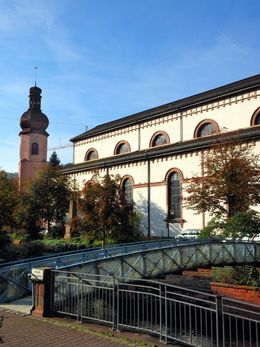
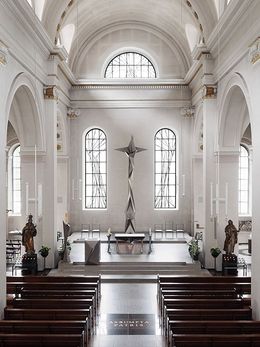
St. Maria church in Schramberg, one of the most important late-classical churches in southern Germany, was built between 1838 and 1844 according to plans by building inspector Carl Christian Nieffer (1787-?). Nieffer, a student of the Stuttgart architect and court architect Nikolaus Friedrich Thouret (1767-1845), designed the church in the style of a late antique basilica. However, unlike early-classical churches in southern Germany, such as St. Blasien (cathedral) or St. James' Church in Hechingen, he based the church's design on the principles of state architecture. This resulted in the solemn austerity of the interior, which is axially symmetrical and whose main dimensions are in a 2:1 ratio. The Ionic stylistic elements, such as capitals, rosettes, cornice, and architrave, are only fully developed in the chancel. The three-aisled church with its large barrel vault, together with the altar area design created in 1994 by Professor Erich Hauser (born 1930), represents a successful fusion of late Neoclassical architecture and contemporary art. The Baroque onion dome originates from the former St. Nicholas Church and is now considered a landmark of Schramberg. Also noteworthy are the expressive Stations of the Cross by Sepp Biehler (1907-1973) and the Nativity triptych by Gämmerler-Hauser-Scheller.
Source: Rudi Schäfer, Schramberg
Source: Rudi Schäfer, Schramberg



 ;
;